Donut Clicker


Be the first to comment
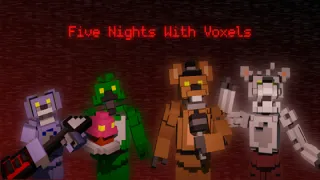
Five Nights With Voxels reimagines classic survival horror by shifting the familiar tension of animatronic survival into a fully voxel-based 3D world. At first glance, the aesthetic seems harmless—simple cubes forming characters and environments. But that illusion breaks quickly under pressure.
So, how can something “blocky” be so terrifying?
The game’s defining feature is its voxel art style, where every animatronic, hallway, and object is constructed from rigid cubic forms. This simplicity creates a powerful psychological effect: the uncanny valley, where familiar shapes feel subtly wrong.
Instead of smooth realism, the horror comes from abstraction. The lack of detail forces players to focus on movement, sound, and anticipation—amplifying fear through imagination.
Lighting plays a crucial role as well. In this cubic world, shadows are sharp, segmented, and unpredictable. Darkness doesn’t just hide threats—it reshapes the environment itself, making every corner feel uncertain and unsafe.
Five Nights With Voxels remains faithful to the legendary FNAF 1 formula. The familiar power management tension is still the heart of the experience—every camera check, door activation, and light usage drains limited energy.
However, the game introduces a subtle voxel twist.
These changes make the experience feel fresh while preserving the original’s anxiety-driven gameplay loop.
One of the most engaging features is Custom Night Mode, offering a full 0–20 difficulty scale. Players can fine-tune animatronic aggression, creating anything from a beginner-friendly experience to an overwhelming survival gauntlet.
This system dramatically boosts replayability. Even after surviving Night 5, players return to
It transforms the game from a linear horror experience into a personal challenge sandbox.
Fan-made creations like Five Nights With Voxels play a vital role in keeping horror franchises alive and evolving. They allow developers to experiment with new visual styles, mechanics, and interpretations while preserving the essence of the original experience.